If you are planning solar or thinking about adding a solar battery later, understanding your inverter choice is imp...
Mar 18, 2026
Apr 13, 2026
Share post on


Is your home using a large amount of electricity every day? Do you have a big solar system and still export a lot of unused energy to the grid?
If yes, a larger home battery may be worth considering. As solar adoption grows across Australia, some households are now looking beyond standard battery sizes and exploring higher-capacity storage options.
One such option is the 28kWh solar battery system. The guide explains what this battery size means, when it makes sense for Australian homes, and how to decide whether it suits your energy needs.
A 28kWh battery is designed to store a large amount of solar energy produced during the day. This stored energy can then be used in the evening, overnight, or even into the next morning.
Most standard residential batteries in Australia range from 10kWh to 15kWh. A 28kWh system is therefore considered a large home solar battery system, built for households with higher electricity demand.
In practical terms, a battery of this size may provide around 24–26kWh of usable storage, depending on the manufacturer. It can support more appliances and longer periods of energy use compared to smaller batteries.
Because of its size, this type of battery is usually suited to larger homes or households with high daily electricity consumption rather than the average residence.
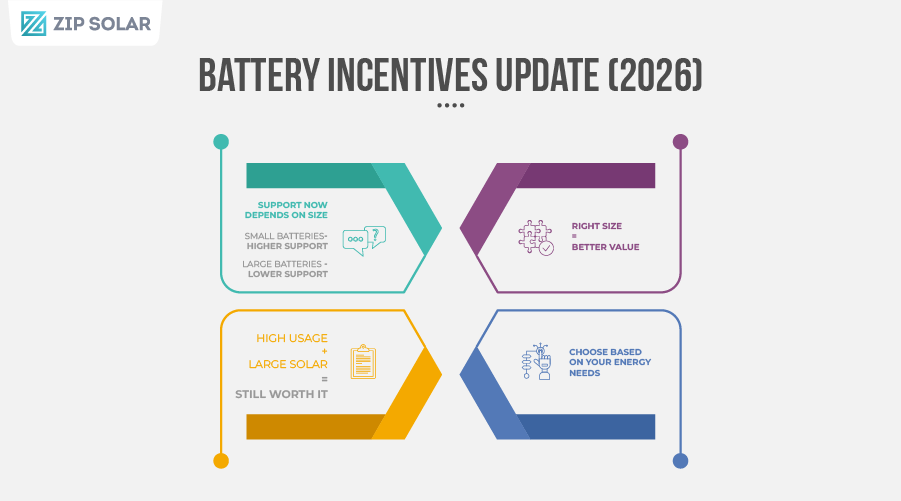
The federal battery incentive program continues to support home energy storage across Australia. However, the support structure was adjusted from 1 May 2026.
Batteries up to a certain size receive stronger support, while larger systems receive relatively less support. The goal is to encourage households to choose a battery that matches their actual energy needs.
It does not mean larger battery systems are no longer worthwhile. For homes with high electricity use and large solar systems, a bigger battery can still provide meaningful long-term value.
The key decision is not about policy deadlines. It is about choosing the right size for your energy profile.
The value of a solar battery depends on two main factors:
Homes with higher daily usage often generate and consume more energy. In these cases, a larger battery can help store surplus solar electricity and reduce reliance on grid power.
For example, households with daily usage above 30–40kWh may benefit more from a larger storage capacity. It is especially true if energy demand continues into the evening or overnight.

Large batteries work best when combined with large solar arrays.
A 10kW rooftop installation can generate roughly 35–45kWh of electricity per day in favourable sunlight conditions. After covering daytime household consumption, the remaining energy can be stored in the battery.
On good solar days, a 28kWh battery may be partially or fully charged depending on weather and electricity use.
Bigger systems may generate 45–60kWh or more per day. It increases the likelihood of consistently charging a large battery.
In such setups, stored solar energy can help power the home through the evening and into the following morning.
Some homes naturally have higher electricity consumption. It can be due to:
When daily usage regularly exceeds 30–40kWh, a larger battery can help shift more solar energy into night-time use.
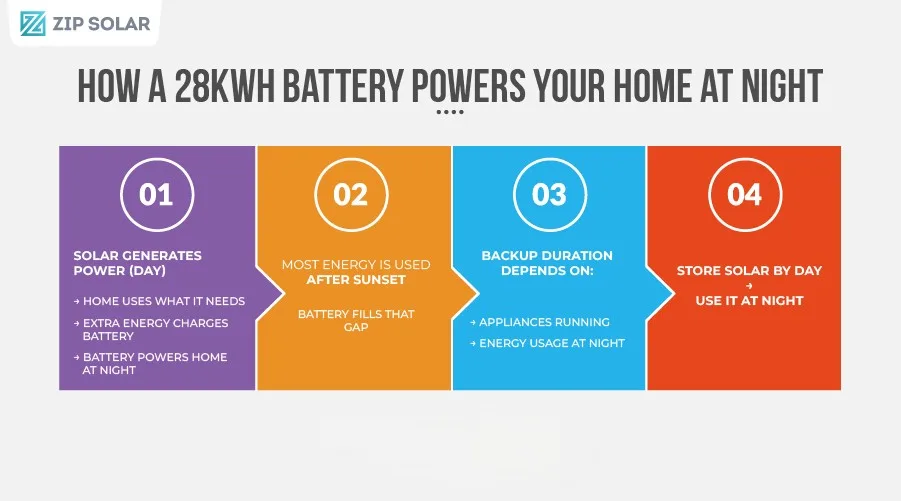
Solar panels produce the most electricity during daylight hours. However, many households use more energy after sunset.
A battery stores surplus solar energy during the day and makes it available later. It typical cycle works as follows:
While a large battery can support extended energy use, how long it lasts depends on the appliances running at night. Realistic expectations are important when planning storage capacity.
Feed-in tariff rates have gradually declined across many Australian states. It means that exporting surplus solar energy often yields only a limited financial return.
Using solar energy in the home, or storing it for later use, can provide greater value. It is known as solar self-consumption.
For households with large solar systems, storing more surplus energy in a larger battery can help reduce reliance on the grid and improve overall system efficiency.
A large battery may suit households such as:
These are general examples. Actual suitability depends on individual energy patterns and solar performance.
A battery of this size needs enough surplus solar energy to charge regularly.
Homeowners should consider:
If daytime consumption is already high, there may be less solar energy left to charge the battery. A professional energy assessment can help determine the right system size.
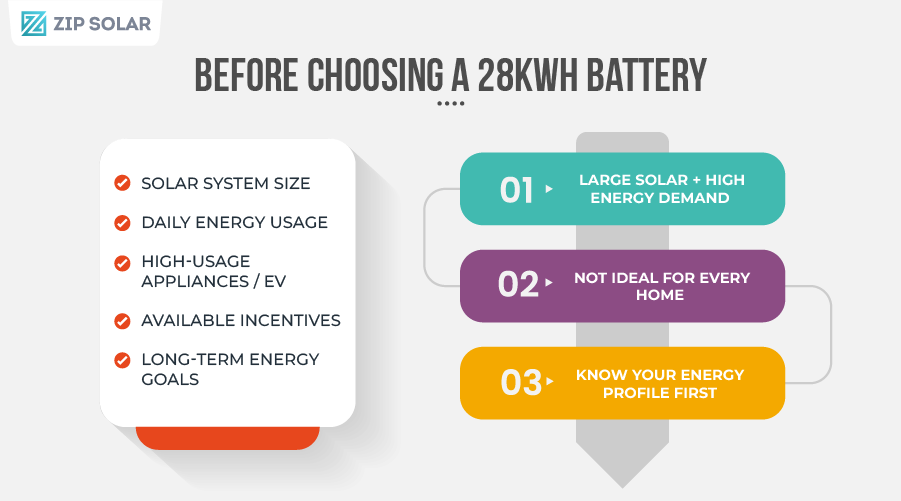
Before installing a large battery, it is important to review:
A 28kWh battery is not suitable for every home. It generally works best for households with large solar systems and consistently high energy demand.
Understanding your energy profile can help you make a confident and informed decision.

A solar system of 10kW or larger is usually recommended for this battery size. The ability to charge the battery depends on how much solar energy is generated each day after covering normal daytime household electricity use.
For many average homes, yes. This battery size is best suited to larger households with higher electricity demand, larger solar installations, or homes that regularly run multiple high-energy appliances.
Yes. Batteries can still help increase solar self-consumption and reduce reliance on grid electricity over time, even though incentive structures have been adjusted. Long-term value depends on energy usage and system sizing.
Often this is possible, but compatibility depends on the inverter type, the system's age, and the available electrical capacity in the home. A professional installer assessment is recommended before making a purchase decision.
Depending on electricity use, it may supply energy for 6–15 hours during evening and overnight periods. Running high-power appliances such as air conditioning or EV charging can shorten the duration of stored energy.
Yes. Home EV charging increases night-time electricity demand. A larger battery can store excess solar energy during the day and use it later to support partial or full vehicle charging at night.

If you are planning solar or thinking about adding a solar battery later, understanding your inverter choice is imp...
Mar 18, 2026
Electricity prices across Australia have risen steadily, and feed-in tariffs, which you are paid for exporting exce...
Mar 10, 2026

Living costs in Queensland have continued to rise, and electricity bills are one of the biggest concerns for many h...
Feb 02, 2026

Rebate Reduction Starts
1st May 2026 – Don’t Miss Out