Living costs in Queensland have continued to rise, and electricity bills are one of the biggest concerns for many h...
Feb 02, 2026

Mar 10, 2026
Share post on


Electricity prices across Australia have risen steadily, and feed-in tariffs, which you’re paid for exporting excess solar, have dropped in many states.
That means sending unused solar to the grid is now less rewarding than it once was. As a result, more homeowners are looking at batteries to store daytime solar and use it at night when grid power costs more.
So the key question is: is a solar battery worth it right now, or should you wait?
The answer depends on your usage patterns, your solar setup, available rebates, and your long-term goals.
Let’s go through the real payback, current battery rebates, practical performance, and timing so you can make a clear decision.
A solar battery stores extra electricity generated by your panels during the day so you can use it later.
Without a battery, unused solar is exported to the grid. With one, that energy is stored for evening and early-morning use, when households typically draw the most power.
It reduces the amount of electricity you need to buy from your retailer and increases your self-consumption of solar energy.
A battery does not automatically make your home off-grid. Most systems stay grid-connected and are designed to reduce dependence, not replace the grid entirely unless specifically built for off-grid use.
There is no universal yes or no. When people ask if a solar battery is worth it, the honest answer is that it depends on how and when you use electricity.
Batteries usually deliver the most value for homes with high evening usage, for example, families running air conditioning at night or using major appliances after sunset.
Homes receiving very low feed-in tariffs also benefit more from storing energy instead of exporting it.
Homes with mostly daytime usage may see slower financial returns.
In these cases, a battery can still provide backup and energy independence, but not fast payback. The decision is both practical and financial.
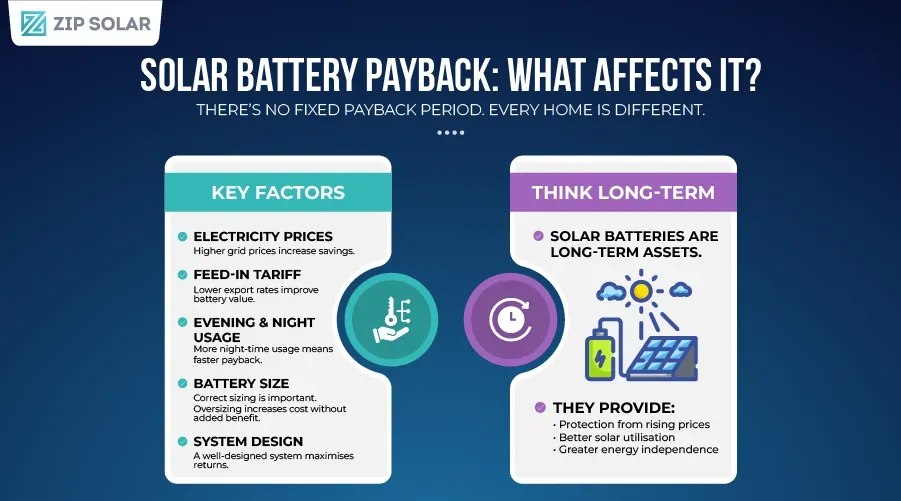
There is no fixed payback period for solar batteries. Results vary by household.
Key factors include:
Higher grid prices and low export rates improve battery value. Correct sizing also matters. Oversized batteries increase cost without proportional benefit.
Batteries should be viewed as long-term assets. Looking only at short payback can miss the value of price protection and better solar utilisation.
Rebates reduce upfront costs and are a major factor in today’s decision. The main solar battery rebate currently comes through a federal scheme supporting eligible installations nationwide.
The rebate is usually applied as a point-of-sale discount through approved installers rather than paid directly to homeowners. Some states offer additional incentives or finance programs, though compatibility varies.
Actual value depends on battery size, eligibility, and compliant installation, not headline “after-rebate” ads.
The Cheaper Home Batteries Program is the main federal battery incentive. It supports eligible systems across Australia through certificate-based discounts handled by approved installers.
From 1 May 2026, program changes created a more predictable rebate structure and better alignment with common household battery sizes. Support levels are designed to taper gradually over time as battery prices fall.
It affects timing decisions not through urgency but through clarity. The program will continue, but incentive levels are scheduled to step down. Waiting several years may mean lower support even if hardware prices reduce.
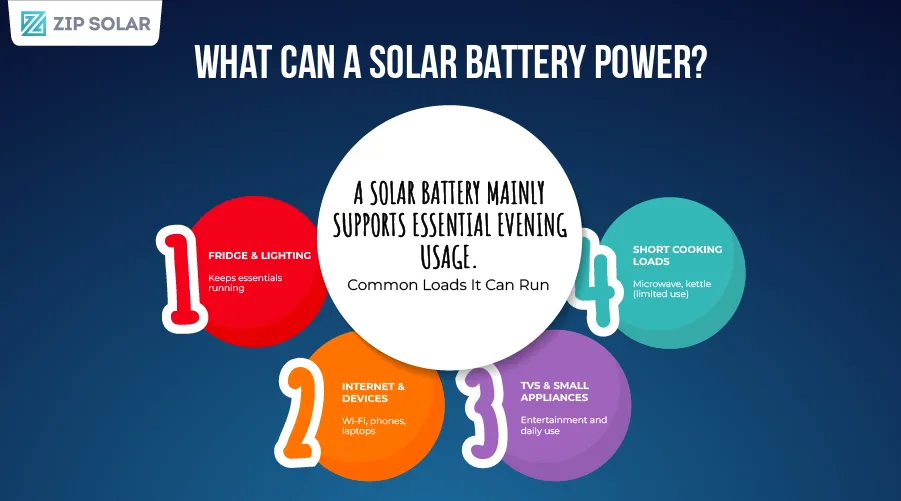
A battery usually supports essential evening loads, such as:
Air conditioning can be supported to a limited extent, depending on the battery's size and output.
Blackout backup only works if the system is designed for it and usually covers selected circuits, not the entire home. A battery should be seen as evening support and essential backup, not unlimited whole-house power.
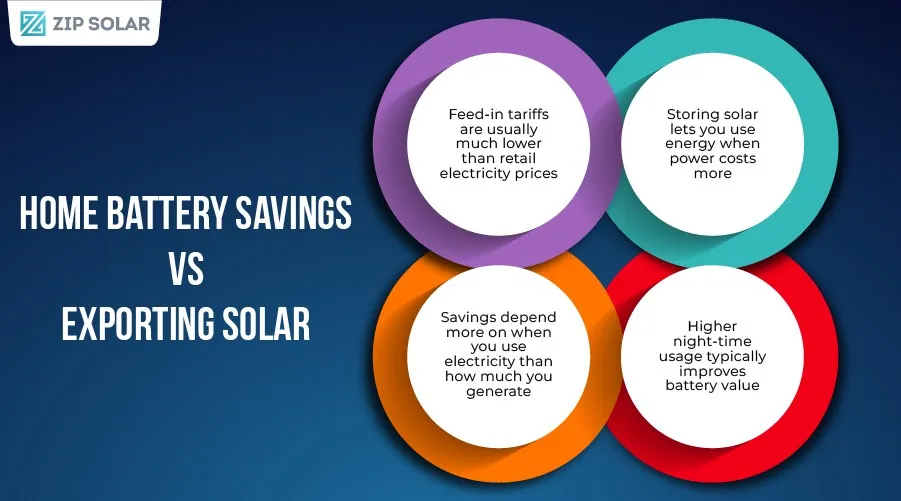
Many solar homes still export a large share of their daytime energy to the grid. The challenge today is that feed-in tariffs in most parts of Australia are much lower than retail electricity prices. That changes the value equation.
Home battery savings come from using more of your own solar power instead of exporting it cheaply and buying it back later at a higher rate.
Key points to understand:
In simple terms, self-consumption is now more valuable than exporting.
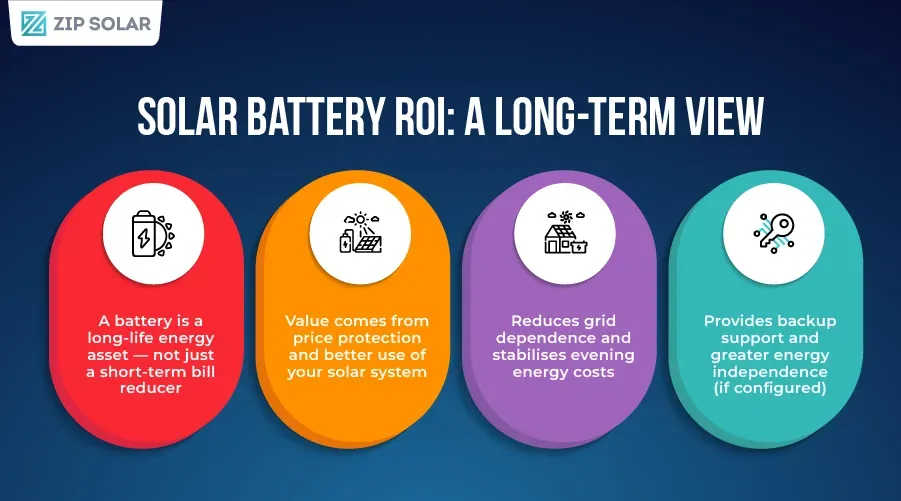
When evaluating battery value, it helps to step back and consider the long-term picture. A battery is not just a short-term bill reducer. It’s a long-life energy asset.
Most modern home batteries are designed to operate for many years under normal household use, with performance gradually declining over time rather than suddenly stopping.
The real solar battery return on investment comes from a mix of financial and practical benefits, not just the speed of simple payback.
Think of long-term value in these ways:
Some benefits are measurable in dollars, while others are about comfort and risk reduction.
For many homeowners, the decision is partly financial and partly about resilience, especially in areas with grid instability or frequent peak pricing.
Choosing the right installer matters just as much as choosing the right battery. System design, sizing, and compliance all affect real-world performance and payback.
That’s why many homeowners look for experienced, standards-aligned providers rather than one-size-fits-all installs.
Zip Solar is a NETCC-approved solar retailer working with compliant products and qualified installers across Australia.
The focus is on a well-designed system based on your household’s actual energy use, not generic packages. It includes reviewing your daytime generation, evening consumption, roof layout, inverter capacity, and realistic storage needs before recommending a battery size.
Zip Solar also stays up to date on current battery rebates and program rules, including the Cheaper Home Batteries Program, and clearly explains eligibility and expected outcomes before installation.
Homeowners receive plain-language guidance on payback expectations, backup capability, and limitations.
The goal is simple: informed decisions, compliant installs, and ongoing support, not pressure selling.
If you’re still unsure whether a battery makes sense for your home, it helps to get advice based on your actual energy use, not averages or marketing claims.
Every household is different, and the right answer depends on your solar output, evening consumption, tariff rates, and rebate eligibility.
You can contact Zip Solar for guidance based on your usage patterns, realistic payback expectations, and current battery rebate settings, including the Cheaper Home Batteries Program.
A proper assessment can help you decide with clarity and confidence whether you choose to install now or later.

It can be, but not for every home. A battery makes the most sense if you use a lot of electricity in the evening, receive low feed-in tariffs, and want more control over your power use. If most of your usage occurs during the day while your solar is already producing, the financial benefit may accrue more slowly. When people ask is solar battery is worth it, the right answer depends on usage patterns, not just system size.
Most modern home batteries are designed to last many years under normal use. Manufacturers usually provide long performance warranties, and capacity typically reduces gradually over time rather than stopping suddenly. Actual lifespan depends on usage cycles, temperature, and system design.
Battery prices have generally trended down over time, but not always in a straight line. At the same time, rebates and incentives are designed to gradually reduce. While hardware may become cheaper, the availability of support may also decrease. Timing decisions should consider both price trends and incentive levels.
Yes. Many batteries can be added to existing solar setups. Compatibility depends on your inverter type, system size, and wiring layout. Some homes may need inverter upgrades or additional equipment.
Only batteries installed with blackout backup capability will provide power during an outage. Even then, they usually support selected circuits, not the entire house. Backup design must be planned during installation.
It can support limited air conditioning use, depending on the battery size and output rating. Heavy, all-night cooling for a whole house usually requires a larger, carefully designed system.
In most current programs, yes. Federal battery incentives are generally designed for batteries connected to solar systems, either existing or newly installed.
There is no single “standard” size. Many homes choose moderate storage sized around their evening usage, not their total daily consumption. Correct sizing improves value and payback.
Often, yes, because the system can be designed as one integrated setup. But adding a battery later is also common and can work well if compatibility is checked.

Living costs in Queensland have continued to rise, and electricity bills are one of the biggest concerns for many h...
Feb 02, 2026
Electricity prices across Australia have continued to rise in 2025-26, and many households are feeling the pressure...
Jan 14, 2026

Electricity prices in Australia continue to rise, and many households are seeking ways to reduce costs and remain i...
Oct 14, 2025

Rebate Reduction Starts
1st May 2026 – Don’t Miss Out