Do you feel like you’ve missed the solar battery incentive
Jun 14, 2026

July 8, 2026
Share post on


Are you thinking about installing solar panels or a home battery but worried about the upfront cost?
Would interest-free finance make upgrading your home more affordable?
If so, you’re not alone.
With electricity prices continuing to rise across NSW, more homeowners are looking for ways to reduce their power bills and rely less on the grid. Solar panels and battery storage are becoming increasingly popular, but the upfront investment can still be a challenge.
That’s where the NSW Home Energy Saver Program comes in.
The program offers eligible households interest-free loans of up to $15,000 over 10 years to help pay for approved energy upgrades. Some lower-income households may also qualify for discounts of up to $4,000, depending on their eligibility.
But is using the loan actually the right financial decision?
Let’s start by understanding how the program works.
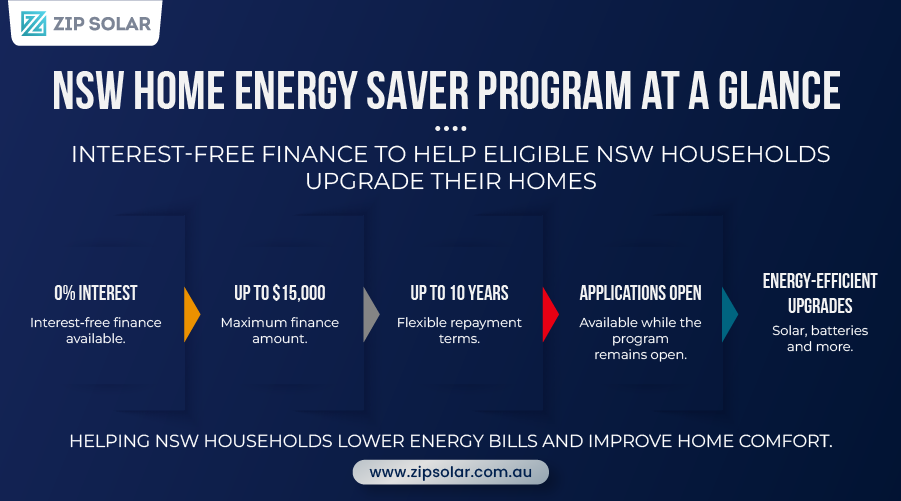
The NSW home energy saver program is an NSW government initiative designed to help eligible households make energy-efficient upgrades to lower electricity bills and improve home comfort.
Instead of paying the full cost upfront, eligible homeowners can apply for interest-free finance to install approved products such as solar panels, batteries, and other energy-saving improvements.
Here’s a quick overview.
|
Feature |
Details |
|
Interest Rate |
0% (Interest-Free) |
|
Maximum Finance |
Up to $15,000 |
|
Repayment Term |
Up to 10 years |
|
Available Now |
Yes |
|
Closing Date |
Available while the program remains open |
|
Eligible Upgrades |
Solar panels, home batteries, heat pump hot water systems, insulation, draught proofing, induction cooktops and more |
The program is designed to help eligible households make energy upgrades sooner by removing one of the biggest barriers, the upfront cost.
While the interest-free loan is available now, some households may also qualify for additional government discounts. Understanding the difference is important before applying.
Many people assume the home energy saver program only offers a loan.
In reality, it can include two different types of support, depending on your circumstances.
|
Feature |
Interest-Free Loan |
Home Energy Saver Discount |
|
Available Now |
Yes |
Coming Later in 2026 |
|
Value |
Finance up to $15,000 |
Up to $4,000 |
|
Income Limit |
Household income limits apply |
Up to $80,000 |
|
Eligible Applicants |
Eligible homeowners |
Homeowners, Renters & Concession Card Holders |
|
Repayment |
Yes |
No repayment required |
The difference is straightforward.
The loan is available to eligible households with a combined taxable income of up to $210,000, while the discount is aimed at eligible lower-income households and concession card holders.
Now that you know what’s available, let’s look at why so many NSW homeowners are considering this program in the first place.
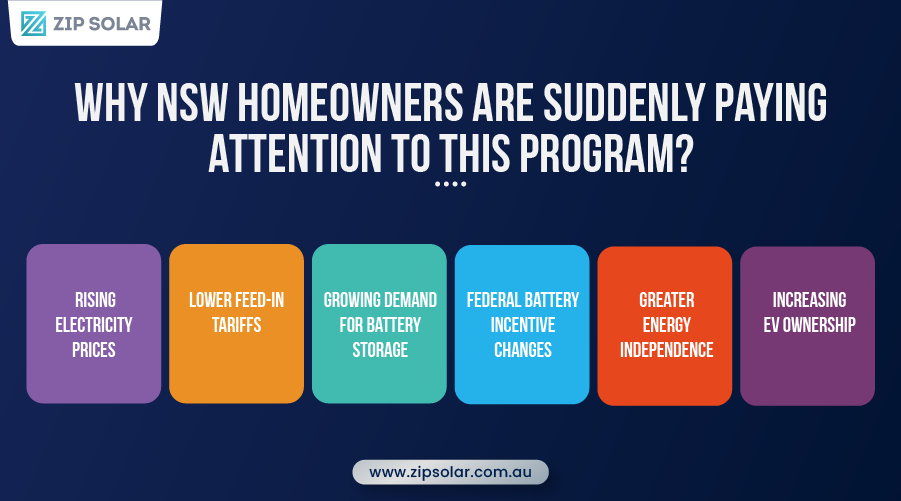
Several changes have made energy upgrades more attractive than ever.
Higher electricity bills mean more households are looking for ways to reduce their dependence on grid power.
IPART’s benchmark feed-in tariff for 2026–27 is 3.4–6.5 cents per kWh, making self-consumption more valuable than exporting excess solar energy. This makes using your own solar energy more valuable than sending it back to the grid.
Adding a battery allows homeowners to store excess solar energy during the day and use it in the evening, when electricity demand is usually highest.
The federal home battery program introduced changes after May 2026 that place greater emphasis on choosing the right battery size rather than simply installing the largest system.
Many homeowners want more control over their electricity costs and less reliance on rising retail energy prices.
As more families purchase electric vehicles, household electricity demand is increasing. Solar panels paired with battery storage can help offset some of these additional charging costs.
With more homeowners exploring the program, the next question is whether you’re actually eligible to apply.
Not every household automatically qualifies for the NSW Home Energy Saver Loan, so it’s important to check the eligibility requirements before planning your upgrade.
Here’s a general overview.
|
Requirement |
Eligibility |
|
NSW Property |
Must be located in NSW |
|
Australian Citizen or Permanent Resident |
Required |
|
Combined Household Income |
Up to $210,000 taxable household income |
|
Homeowner |
Eligible |
|
Landlord |
May be eligible for certain upgrades |
Yes. Eligible landlords may be able to access the program for approved energy upgrades on residential investment properties, provided they meet the program requirements.
In most cases, renters cannot apply directly because approval is generally linked to the property owner. However, landlords may choose to participate and upgrade eligible rental properties where permitted under the program.
Once you’ve confirmed you’re eligible, the next step is understanding exactly what the interest-free finance can be used for.
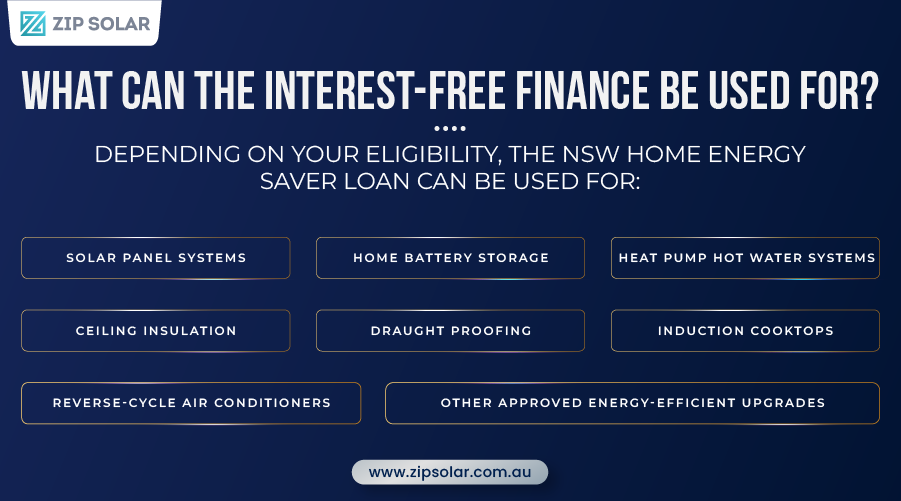
The NSW Home Energy Saver Program supports a range of approved upgrades that can improve your home’s energy efficiency and reduce ongoing electricity costs.
Depending on your eligibility, the NSW home energy saver loan can be used for:
While every upgrade offers benefits, solar panels and battery storage are often among the most effective ways to lower long-term electricity costs, especially for homes with high daytime solar generation and evening energy use.
This is why many homeowners are choosing to invest in solar and batteries while interest-free finance is available.
Solar panels reduce the amount of electricity you buy during the day.
A battery extends those savings into the evening by storing excess solar energy instead of exporting it to the grid.
Together, they can help you:
Because the loan is interest-free, many homeowners find it easier to spread the cost over several years rather than paying a large amount upfront.
The important part is choosing a system that’s the right size for your home.
That raises the next question, should you finance solar panels, a battery, or both?
The answer depends on your current setup and future energy needs.
|
If You Have… |
A Good Option Could Be… |
|
No solar |
Install solar panels first |
|
Solar but no battery |
Add battery storage |
|
Older, undersized solar |
Upgrade solar before adding a battery |
|
Large daytime exports |
Battery storage may improve self-consumption |
|
Growing electricity usage or EV plans |
Solar and battery together |
If you’re starting from scratch, combining solar panels with a battery often provides the greatest long-term flexibility.
If you already have solar, adding a battery may be enough; provided your system generates sufficient excess energy.
Before deciding, it’s helpful to understand how interest-free finance could affect your overall costs.
The exact savings depend on:
Rather than focusing only on monthly repayments, consider how much grid electricity your new system could replace over time.
Here’s a simple example.
|
Example Only |
|
|
System Cost |
$15,000 |
|
Loan Amount |
$15,000 |
|
Interest Rate |
0% |
|
Loan Term |
10 years |
|
Approximate Monthly Repayment |
Around $125 |
At the same time, your solar and battery system could reduce your electricity bills, helping offset part of the repayment. The exact outcome will vary for every household, so it’s worth requesting a personalized assessment before making a decision.
Using interest-free finance can make sense, but only if you invest in the right system.
Many people focus on the fact that the loan has 0% interest.
But they spend far less time thinking about what they’re actually financing.
Some common mistakes include:
Remember, an interest-free loan doesn’t automatically make every purchase a good investment.
A correctly sized solar and battery system will usually deliver better value than simply installing the biggest system your loan allows.
This is especially true for homeowners who already have solar panels.
If you already have rooftop solar, you don’t necessarily need to replace the entire system.
The NSW Home Energy Saver Program may help you finance upgrades such as:
Before choosing an upgrade, it’s worth checking:
For many homeowners, upgrading an existing system can be more cost-effective than starting again.
However, recent changes to the federal battery incentive also affect which battery size delivers the best value. Understanding those changes can help you make a smarter decision.
The federal home battery program is still available, but the way support is calculated changed after 1 May 2026.
The biggest change is that battery size now plays a much bigger role in determining the level of support.
|
Before May 2026 |
After May 2026 |
|
Similar support across battery sizes |
Tier-based support |
|
Larger batteries often provided greater value |
Right-sized batteries receive better support |
|
Less focus on household usage |
Battery sizing matters more |
This doesn’t mean larger batteries are no longer worthwhile. They can still be the right choice for homes with high electricity demand and large solar systems.
The key is making sure your battery matches your solar generation and household usage.
That brings us to a common issue many homeowners face after installing a battery.
A growing number of homeowners have invested in a large battery, only to discover it rarely reaches a full charge.
The problem often isn’t the battery.
It’s the solar system.
A battery can only store the excess electricity your solar panels generate. If your solar system is too small, the battery may never charge completely, reducing the value of your investment.
If any of these sound familiar, it may be worth reviewing your solar system before adding more battery capacity.
In many cases, increasing solar generation delivers better results than simply installing a larger battery.
Before investing in extra battery capacity, ask whether your solar system is producing enough surplus energy.
The table below provides a simple guide.
|
Current Situation |
Recommended Approach |
|
Battery charges fully most days |
Existing solar may be sufficient |
|
Battery rarely reaches full charge |
Consider adding more solar panels |
|
High daytime electricity use |
Review solar system size first |
|
Planning EV charging |
Assess both solar and battery capacity |
|
Frequent grid usage at night |
Check whether more solar generation is needed |
Adding more battery storage without increasing solar production may simply leave part of the battery unused.
The best results usually come from balancing both solar generation and battery capacity.
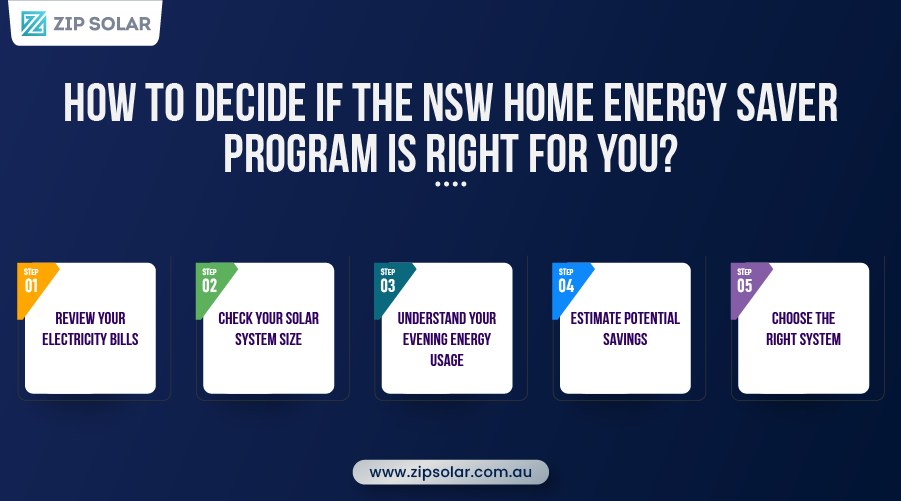
Before applying, spend a few minutes reviewing your home’s energy needs.
Check how much electricity your household uses each day and when that usage occurs.
If you already have solar, estimate how much excess electricity your system generates on a typical day.
A battery delivers the most value when a large portion of your electricity is used after sunset.
Think about how much grid electricity you could replace with your own stored solar energy.
Select a solar and battery system that matches your energy needs; not simply the largest system available through the loan.
Taking these steps can help you make a more informed investment and maximise the value of the program.
Before applying for the NSW Government solar loan, ask yourself:
Answering these questions early can help you avoid unnecessary costs later.
It’s also worth weighing up the advantages and limitations of interest-free finance before making your decision.
Interest-free finance works best when combined with a well-designed solar and battery system that matches your household’s energy needs.
The NSW Home Energy Saver Program gives eligible homeowners an opportunity to invest in energy-efficient upgrades without paying the full cost upfront.
However, the loan itself isn’t the biggest advantage.
The real value comes from choosing the right combination of solar panels, battery storage, and system upgrades for your home.
Before applying, review your electricity usage, check whether your solar system is battery-ready, and choose equipment that matches your long-term energy needs.
A well-planned system can help lower electricity bills for years to come, making the decision far more valuable than the finance alone.

Every home uses electricity differently.
That’s why the best solution isn’t always the biggest system; it’s the one that’s designed around your energy usage, solar generation, and future plans.
The team at Zip Solar can help you assess your current system, explain the available finance options, and recommend the right upgrade for your home.
Do you feel like you’ve missed the solar battery incentive
Jun 14, 2026
Are your electricity bills still high even after installing solar panels?
Apr 14, 2026
Is your home using a large amount of electricity every day? Do you have a big solar system and still export a lot o...
Apr 13, 2026
Massive Price Drop Offer Ends
15 Oct 2026 – Don’t Miss Out