Have you noticed cracks, discolouration or other visible damage on your solar panels?
Oct 23, 2026

June 11, 2026
Share post on


Do you feel like you’ve missed the solar battery incentive? Are you now unsure whether installing a battery still makes sense?
It’s a common concern, especially after the recent changes to the structure of battery incentives in Australia.
At the same time, solar adoption continues to grow. Australia now has over 4 million rooftop solar systems installed, but only a small share of those homes have battery storage.
The gap is one of the key reasons battery incentives still exist today.
The important thing to understand is this: the incentive hasn’t disappeared. What has changed is how it applies.
To make the right decision now, it’s important to understand what actually changed and what it means for your home.
Let’s start by answering the most important question. Did you actually miss the solar battery incentive?
The short answer is no, you didn’t.
The solar battery incentive is still available in Australia and continues to apply to battery systems up to 100kWh. What has changed is not the availability of the incentive, but the way it is structured.
Earlier, the benefit was more broadly applied across different battery sizes. Now, support is more closely tied to your battery system's size.
It means the outcome depends less on when you install and more on what size you choose.
For homeowners, this is an important shift.
Instead of trying to install quickly to “lock in” benefits, the focus is now on choosing a battery that matches your actual energy usage and solar generation. A well-sized system is more likely to deliver consistent long-term value.
So, rather than asking whether you missed the incentive, the better question is: what exactly changed, and how does that affect your decision today?
The biggest change after May 2026 is how the incentive is applied.
Earlier, the benefit was more evenly spread across different battery sizes. Now, the support level depends on the size of your battery system. The shift is designed to encourage homeowners to choose a battery that fits their actual energy needs.
Here’s a simple comparison:
|
Aspect |
Before May 2026 |
After May 2026 |
|
Incentive Structure |
More uniform across sizes |
Based on battery size |
|
Focus |
Install early |
Install the right size |
|
Best Value |
Similar across most systems |
Smaller, well-sized systems |
|
Support Level |
Less variation by size |
Decreases as size increases |
|
Decision Factor |
Timing |
Correct sizing |
In practical terms:
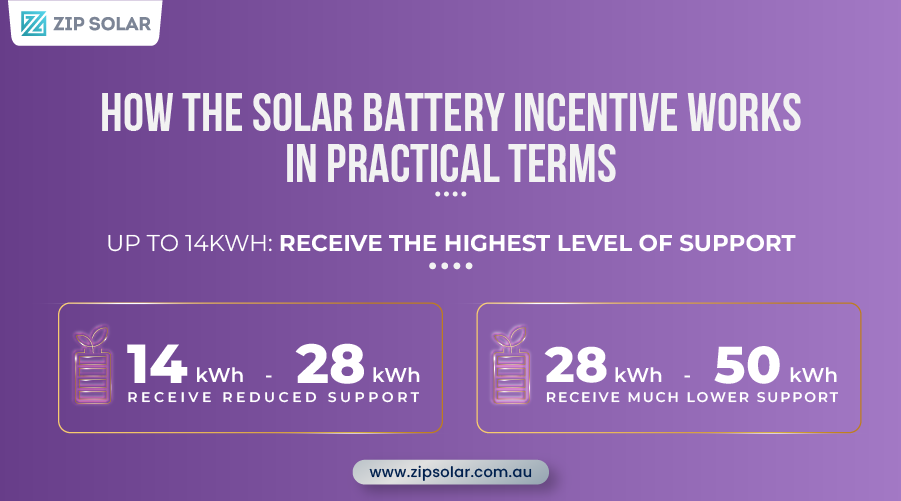
It does not mean larger batteries are no longer useful. It simply means that the incentive now rewards systems that are better aligned with household energy usage.
For homeowners, the takeaway is straightforward: the decision is no longer about installing as soon as possible, but about choosing a system that makes sense for your home.
It naturally leads to the next question: Does this change actually benefit you, or does it make things more complicated?
At first glance, the update may seem like a limitation.
But in reality, it’s designed to help homeowners make better decisions.
Earlier, many people chose larger batteries, thinking it would maximize savings. In many cases, those systems ended up underused simply because the home didn’t generate or consume enough energy to justify their size.
The new structure helps avoid that.
It encourages:
This approach can improve overall value.
A correctly sized battery is more likely to:
In simple terms, the update shifts the focus from “install more” to “install smarter”.
And that matters because many homeowners still fall into the same trap after hearing about changes to incentives.
So before moving ahead, it’s important to understand the most common mistake people make at this stage.
After hearing about changes to the incentive, many homeowners try to “compensate” by going bigger.
This is where things often go wrong.
Common mistakes include:
The assumption is simple: a larger battery will store more energy and yield greater savings.
But that is no longer always true.
If the battery is too large for your home:
A battery works best when it is used consistently, not when it is oversized. That’s why the focus should shift from capacity to suitability.
Before deciding on a battery size, the next step is to review your energy profile. So what should you actually do now to make the right decision?
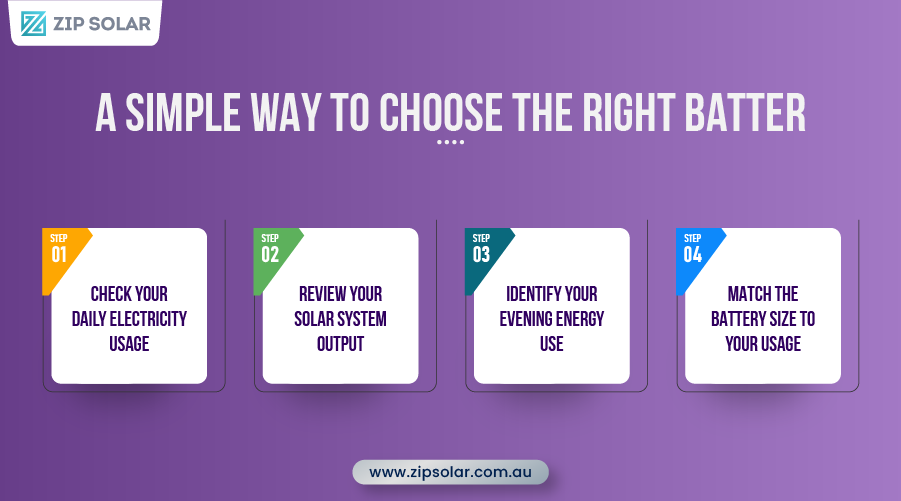
Instead of guessing or relying on outdated advice, the best approach is to look at your own energy usage and work from there. Here’s a simple way to do that:
Start with your electricity bill. Look at how many kilowatt-hours (kWh) your household uses each day on average. It gives you a clear baseline for how much energy your battery actually needs to cover.
Next, understand how much energy your solar system generates. A 6.6kW system produces very differently compared to a 10kW or 13kW system. The more your system generates, the more energy is available to store.
Most homes use the highest amount of electricity after sunset.
Think about:
It is the energy your battery is meant to cover.
Now bring everything together.
The right battery size depends on:
This step is where most of the value comes from.
A well-matched system performs better than a larger system that doesn’t get fully used. Once you have clarity on your usage, the next step becomes much easier.
So what battery sizes actually make sense for homes?
Battery sizing is no longer about choosing the biggest system you can afford. It’s about choosing a size that matches how your home actually uses energy. Two battery sizes are now most relevant for Australian homes, depending on usage and solar system size.
A 14kWh solar battery is the most suitable option for many households. It works well for:
In most cases, this size can:
It is generally the most balanced option in terms of cost, performance, and usage.
A 28kWh solar battery is designed for homes with higher energy demand.
It is more suitable for:
The size provides more storage, but it also requires:
Under the current incentive structure, larger batteries receive relatively lower support, which makes correct sizing even more important. Choosing between these sizes depends entirely on your energy profile.
The right battery size is not based on trends or recommendations, it is based on how your home generates and uses electricity.
This is one of the most common questions right now, and the answer is still yes. But with one condition: it needs to be sized correctly.
The value of a battery has always come from how you use your solar energy, not just the incentive itself. And that hasn’t changed.
Here’s why batteries can still make sense in 2026:
A battery helps shift energy from when it is generated (daytime) to when it is needed (evening). However, this only works well if the system is properly sized.
So the focus should not be on whether batteries are still worth it, but on whether the system is designed correctly for your home.
To make this clearer, let’s look at a couple of real-life scenarios where different battery sizes make sense.
Sometimes, the easiest way to understand battery sizing is to see how it works in real homes.
Here are two simple examples:
In this case, a 14kWh battery is usually the better fit. Why?
A larger battery in this setup may not fully charge every day, reducing its effectiveness.
Here, a 28kWh battery may make more sense. Why?
In this setup, a smaller battery may run out quickly and fail to meet the full demand.

If it feels like you missed the solar battery incentive, it’s easy to hesitate or delay the decision. But the reality is different.
The incentive is still there, the approach has simply shifted towards better sizing and smarter planning.
What matters now is not when you install a battery, but whether the system is right for your home. Before making a decision, take a moment to look at:
These factors will have a much bigger impact on your outcome than the timing of the incentive. The real loss isn’t missing the solar battery incentive, it’s choosing the wrong battery size.
Take the time to understand your energy needs, and you’ll be in a much better position to make the right choice.
You don’t have to figure it out on your own. Get a free quote from Zip Solar. We’ll assess your usage, solar system, and recommend the right battery size for your home
A simple check today can help you avoid an expensive mistake tomorrow.
No. The solar battery incentive is still available for systems up to 100kWh. The structure has changed, but the opportunity to install a battery and benefit from it remains.
The support level now depends on battery size. Smaller systems receive higher relative support, while larger systems receive reduced support. This encourages homeowners to choose a battery that matches their actual energy needs.
Yes, if it is sized correctly. A battery can help you use more of your own solar energy and reduce reliance on grid electricity, which is becoming more important as energy prices rise.
For most Australian households, a 14kWh battery is a practical choice. It balances cost, performance, and incentive efficiency, especially for homes with standard solar systems and moderate energy use.
Yes. Larger systems, such as a 28kWh solar battery, are still suitable for homes with higher electricity usage and larger solar installations. The key is ensuring your system can support and fully utilise the battery.
If the battery is too large, it may not charge fully or be used effectively. If it is too small, it may not cover your energy needs. In both cases, the system's overall value and performance can be affected.
If the battery is too large, it may not charge fully or be used effectively. If it is too small, it may not cover your energy needs. In both cases, the system's overall value and performance can be affected.

Have you noticed cracks, discolouration or other visible damage on your solar panels?
Oct 23, 2026

Are you a Western Australian homeowner planning to install a solar battery?
Oct 20, 2026

If both answers are yes, choosing a battery needs a little more thought than it would for a typical single-phase ho...
Oct 16, 2026

Federal Battery Rebate Reduces From
1 Jan 2027 – Don’t Miss Out