Do you already have solar panels installed on your roof?
Oct 30, 2026
Nov 17, 2026
Share post on


Are rising electricity bills putting pressure on your business's operating costs?
Does your business consume a significant amount of electricity during daylight hours?
If you answered yes to both, investing in commercial solar systems could be a practical way to reduce your reliance on grid electricity and manage long-term energy costs.
Many Australian businesses, from warehouses and manufacturing facilities to offices and retail premises, consume substantial electricity during the day, when solar panels generate power. This creates an opportunity to use more electricity directly on-site rather than purchasing it from the grid.
To help businesses explore this opportunity, Zip Solar is introducing Zip Solar Commercial, its dedicated commercial solar and battery energy storage offering.
Let's explore how commercial solar works, which businesses can benefit and what to consider before investing.
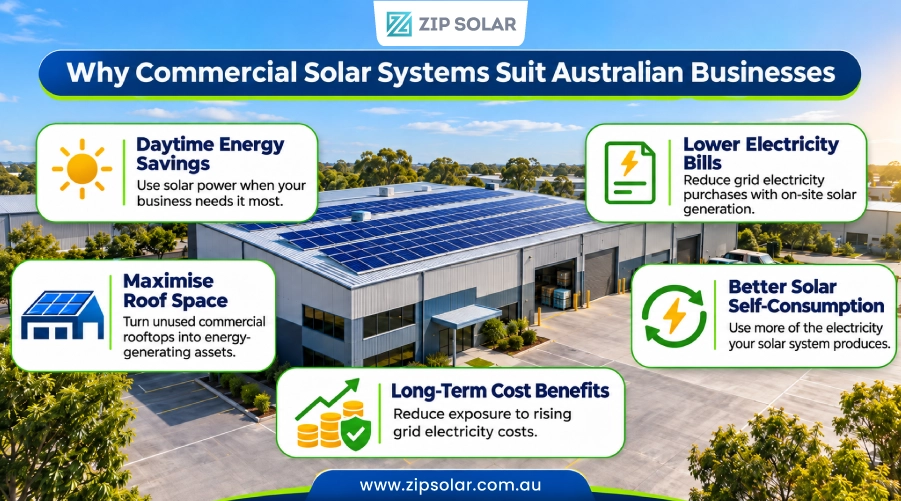
For businesses operating during daylight hours, solar generation can align closely with electricity demand. This means more power can be consumed directly on-site, reducing the amount purchased from the grid.
Every kilowatt-hour of solar electricity used by the business replaces electricity it would otherwise need to buy. This makes commercial solar systems particularly attractive for businesses with consistent daytime energy consumption.
Large roof spaces also create opportunities. Warehouses, factories and distribution centres often have extensive roof areas that may accommodate larger solar arrays, subject to structural suitability and site conditions.
| Business Type | Why Solar Fits |
|---|---|
| Warehouses & distribution centres | Large roof areas with daytime lighting, ventilation and equipment loads |
| Manufacturing facilities | Machinery and production equipment operating during daylight shifts |
| Cold storage facilities | Continuous refrigeration demand, including during solar generation hours |
However, the benefits aren't limited to these industries. Offices, retail stores and other commercial premises can also benefit when their electricity consumption aligns with solar production.
The key is to assess your business's actual energy usage rather than choosing a system based solely on available roof space.
Building on Zip Solar's experience in the Australian solar industry, Zip Solar Commercial provides dedicated solar and battery energy storage solutions for businesses seeking to reduce electricity costs and improve long-term energy efficiency.
The service caters to small and medium businesses, warehouses, manufacturing facilities and larger industrial operations, with commercial solar systems ranging from 20kW to 200kW and beyond.
Businesses can explore system options including:
The right capacity depends on actual energy usage, roof suitability and network requirements rather than business size alone.
The new commercial division builds on Zip Solar's established reputation, including its SunWiz Best Rated Solar Retailer recognition in 2024 and NETCC Approved Seller status.
From initial energy assessment and system design to network approvals, commercial solar installation, commissioning and ongoing monitoring, Zip Solar Commercial manages the project through a coordinated process. This gives businesses a central point of contact throughout their transition to solar.
Choosing the right solar system starts with understanding your business's electricity consumption, operating hours and future energy requirements.
For example, a small office or retail store might suit a 20kW–30kW system, while manufacturing facilities and larger warehouses may require 50kW–100kW or more.
However, bigger isn't always better. Oversizing a system without considering daytime consumption or electricity export limits can affect its financial returns.
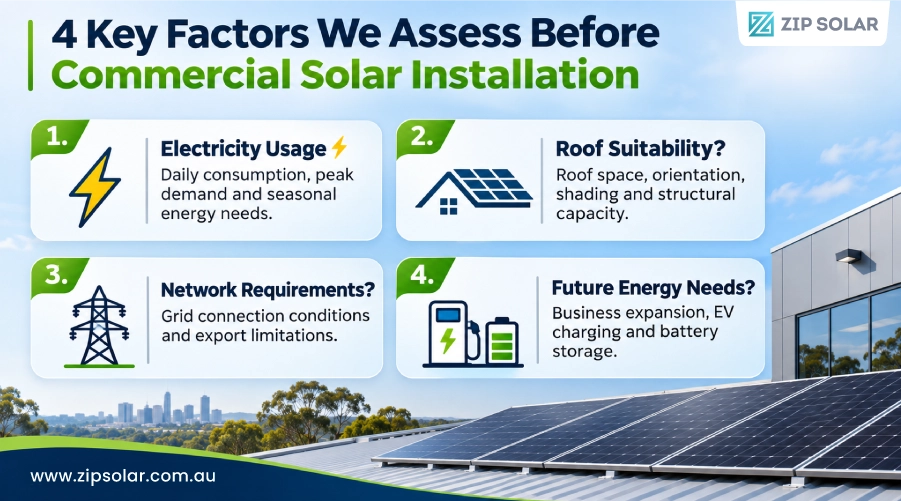
Before recommending solar panels for business, Zip Solar Commercial assesses:
Explore the commercial solar system sizing options to understand how different capacities suit different business operations.
The goal is to match solar generation with actual electricity demand, helping businesses maximise on-site consumption and achieve stronger long-term savings.
A successful commercial solar installation involves more than fitting panels to a roof. It requires careful planning to ensure the system suits the property's energy demand, infrastructure and network requirements.
Here's how the process typically works:
Zip Solar Commercial coordinates these stages to help businesses move from initial assessment to an operational solar system with greater clarity and confidence.
The Clean Energy Council's business solar guidance also highlights the importance of design, approvals and grid connection. For systems claiming federal small-scale incentives, installer accreditation is now administered by Solar Accreditation Australia.
Australian businesses may qualify for government incentives that make commercial solar installation more affordable. The available support depends on system capacity, installation date and business eligibility.
| Incentive | Applies To | What Businesses Should Know |
|---|---|---|
| Small-scale Technology Certificates (STCs) | Eligible solar systems up to 100kW | Can reduce upfront costs. Certificate entitlements generally decrease each year until the scheme ends in 2030. |
| Mid-scale solar (SRES expansion) | Eligible systems above 100kW and up to 1MW installed from 1 October 2026 | Now eligible for STCs with a fixed five-year deeming period. Applications are expected to open in November 2026. |
| Cheaper Home Batteries Program | Eligible households, businesses and community facilities | Provides a discount on qualifying batteries. Support varies by usable capacity under rules introduced on 1 May 2026. |
| Instant asset write-off | Eligible small businesses with aggregated annual turnover below $10 million | A permanent $20,000 per-asset threshold applies from 1 July 2026. Qualifying assets costing $20,000 or more generally enter the small business depreciation pool. |
The Clean Energy Regulator confirms the expanded STC eligibility for mid-scale installations.
Meanwhile, the Cheaper Home Batteries Program may help eligible businesses reduce battery installation costs. The Australian Taxation Office provides guidance on depreciation eligibility.
Because incentives and tax deductions operate differently, businesses should confirm their eligibility with their solar provider and accountant before making an investment decision.
While solar panels generate electricity during daylight hours, commercial solar battery storage allows businesses to store surplus energy for later use.
Zip Solar Commercial offers two battery energy storage system (BESS) ranges, sized to match how much energy your business uses and when it uses it.
BESS4 suits businesses that want to store surplus daytime solar for late-afternoon trading, evening operations or reducing demand charges. BESS5 is built for larger energy users with heavy or round-the-clock loads, such as refrigeration, production lines and processing equipment, where shifting large volumes of stored energy can make a bigger difference to running costs.
| BESS Range | Capacity | Designed For | Suitable Businesses | Rebate |
|---|---|---|---|---|
| BESS4 | 20–200 kWh | Small and medium commercial sites | Warehouses, workshops, retail stores, offices, hospitality venues | Up to $65,800* |
| BESS5 | 200 kWh–30 MWh | Commercial and industrial sites | Factories, cold storage, large warehouses, industrial facilities, agribusiness | Assessed per project |
Battery storage may be particularly useful for cold storage facilities, businesses operating multiple shifts and premises with significant evening or overnight electricity demand.
It can also help businesses facing restrictive export limits by storing electricity that might otherwise go unused. Depending on the system configuration and electricity tariff, batteries may help reduce peak demand charges.
However, battery storage isn't essential for every business. Its financial value depends on when electricity is consumed, the cost of storage and how effectively the battery can be used.
Eligible small businesses may also qualify for federal battery incentives, potentially reducing upfront installation costs.
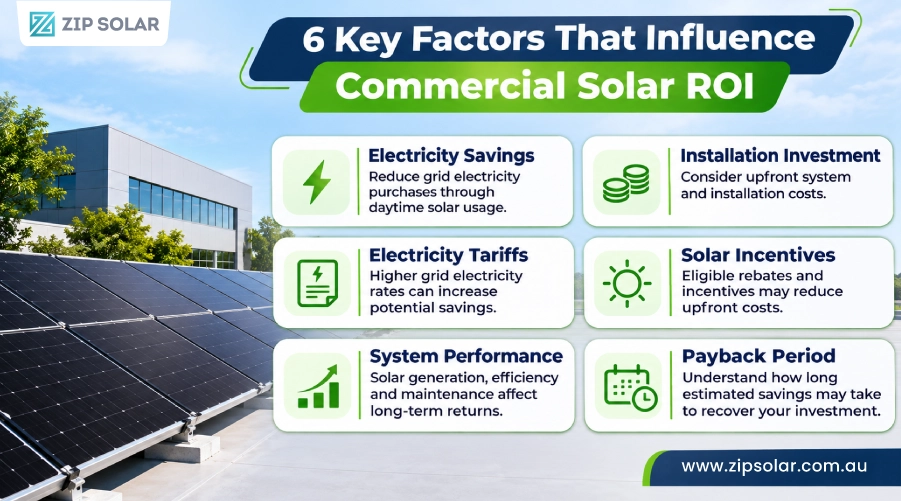
Understanding commercial solar ROI means looking beyond the initial installation price.
A well-designed system should account for electricity savings, upfront investment, ongoing operating costs and expected system performance.
Factors influencing financial returns include daytime electricity consumption, electricity tariffs, network export limits, available incentives and whether battery storage is included.
Businesses should also consider future electricity requirements, maintenance costs and the expected payback period.
Zip Solar Commercial can assess these factors using actual electricity consumption data to help businesses make informed investment decisions.
Here’s how Australian businesses have reduced their energy costs with commercial solar from Zip Solar Commercial.
| Business | System Size | Payback Period | ROI | Key Result |
|---|---|---|---|---|
| Queensland Workwear Supplies | 31.68 kW | 1.4 years | 71.20% | 34.4 tonnes of CO₂ saved |
| Mourat’s Coffee and Nuts | 99 kW | 1.3 years | 76.20% | 86.7 tonnes of CO₂ saved |
| Ceerlitan Building Services & Coabriah Pty Ltd | 151.04 kW | 2.3 years | 42.30% | 64% energy bill savings |
These projects show that system size alone doesn’t decide the return. Queensland Workwear Supplies’ 31.68 kW system paid back in 1.4 years, while the largest system, at 151.04 kW, still paid back in just over two years and cut energy bills by 64%. What matters most is matching the system to how and when the business uses power.

Whether you're planning a new solar installation or upgrading an existing system, Zip Solar Commercial can help you find the right solution for your business.
Our team considers your daytime electricity consumption, energy tariffs, demand charges and network export limits to recommend a suitable system. We also assess roof space, orientation, shading and available government incentives, along with whether your business owns or leases its premises.
With the right system design, your business can reduce its reliance on grid electricity and work towards long-term energy savings.
Explore Zip Solar Commercial and request a tailored energy assessment to discover how solar can benefit your business.
Yes. From 1 October 2026, eligible solar PV systems above 100kW and up to 1MW can receive STCs under the expanded Small-scale Renewable Energy Scheme, subject to the applicable requirements.
Yes, potentially. You'll generally need the property owner's approval and an agreement covering installation, ownership, maintenance and what happens when the lease ends.
Yes. Eligible small businesses can access the federal battery discount for qualifying systems connected to solar. Battery and installer requirements apply, and support is calculated using eligible usable capacity.
Not necessarily. Solar may reduce demand charges when generation coincides with the periods used to calculate peak demand. However, evening peaks or short periods of high electricity consumption may remain unaffected. Battery storage may help when designed appropriately.
Most commercial solar systems now pay back in around 3 to 4 years, down from 7 to 8 years previously. The exact timeframe depends on system size, upfront cost, daytime energy use, electricity tariffs, and available incentives.
Have you noticed cracks, discolouration or other visible damage on your solar panels?
Oct 23, 2026
Are you a Western Australian homeowner planning to install a solar battery?
Oct 20, 2026
Federal Battery Rebate Reduces From
Jan 1
Less Rebate = More Out of Pocket