If both answers are yes, choosing a battery needs a little more thought than it would for a typical single-phase ho...
Oct 16, 2026

Oct 16, 2026
Share post on


Are you a Western Australian homeowner planning to install a solar battery?
Wondering whether you can claim both the state and federal battery rebates?
If you've answered yes to both questions, there's potentially good news. The WA residential battery scheme can work alongside the federal incentive, meaning eligible households may benefit from both programs when installing a battery.
However, eligibility, rebate amounts, and requirements vary by electricity provider and battery configuration.
So, let’s explore how both schemes work, who qualifies, and what you should check before applying.
The WA residential battery scheme is a state government incentive that helps eligible Western Australian households install battery storage.
It operates alongside the federal rebate, with different support levels for Synergy and Horizon Power customers. The state incentive applies to up to 10 kWh of usable battery capacity, subject to eligibility requirements.
Based on the figures in the scheme brief, the WA battery rebate differs by electricity provider.
| Electricity provider | Rebate per usable kWh | Maximum state rebate |
|---|---|---|
| Synergy | $130 | $1,300 |
| Horizon Power | $380 | $3,800 |
Both amounts are calculated based on a maximum usable capacity of 10 kWh, even if the installed battery is larger.
The Synergy battery rebate applies to eligible Synergy customers, while the Horizon Power battery incentive offers a different level of support for eligible households in its service area.
Plenti is identified in the brief as the scheme administrator, helping manage applications and eligibility processes.
Homeowners must also satisfy the scheme's current requirements, including those relating to eligible equipment, installation and participation conditions.
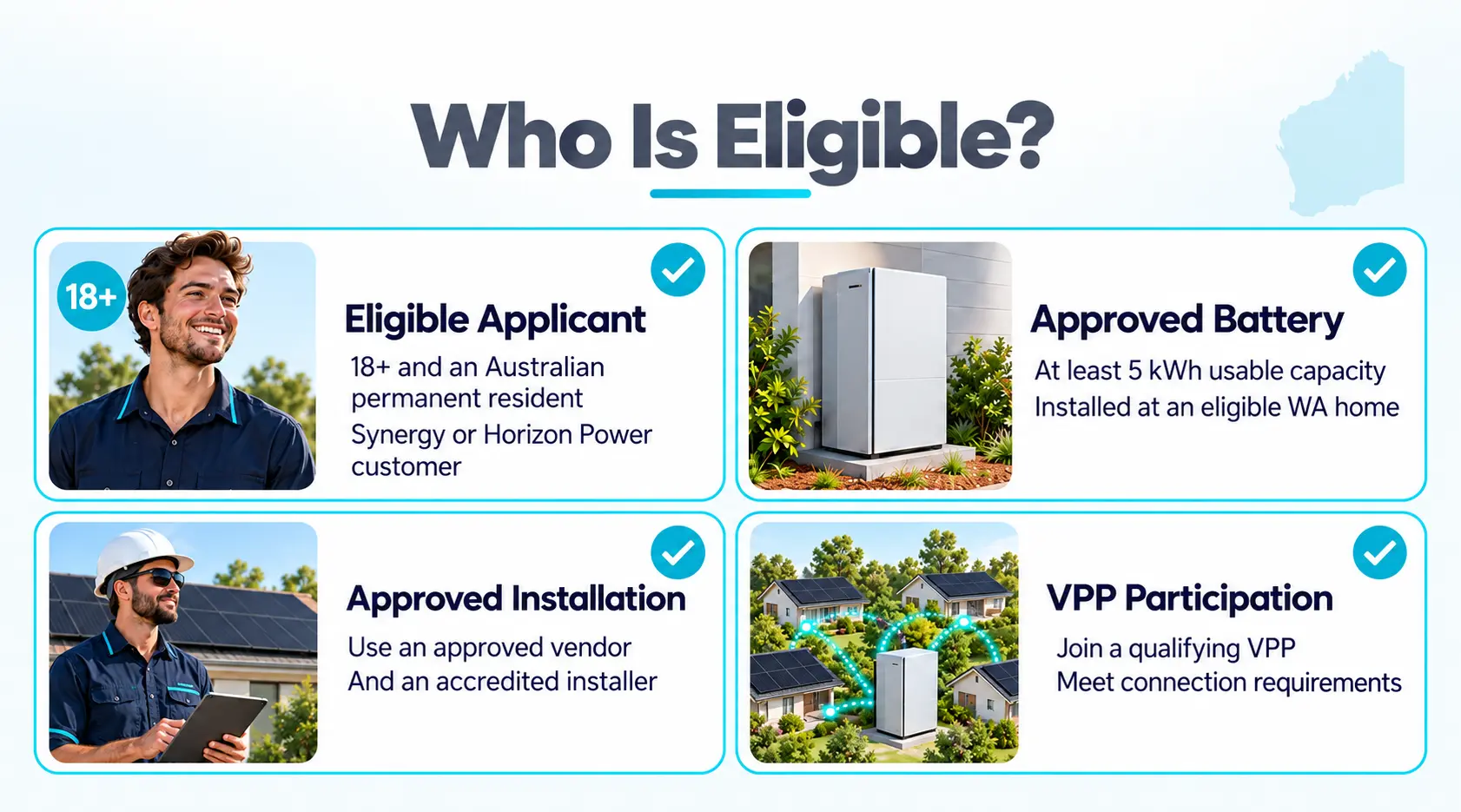
To qualify, applicants generally need to:
The approved vendor submits the rebate application on the homeowner's behalf.
For the full conditions, see the WA Government's Residential Battery Scheme and eligibility requirements.
Alongside the state incentive, eligible WA homeowners can access the federal battery rebate through the Australian Government's Cheaper Home Batteries Program.
Unlike the WA rebate, which has a 10 kWh cap, the federal incentive is delivered through Small-scale Technology Certificates (STCs). The number of certificates depends on the battery's eligible usable capacity, the applicable STC factor and other scheme requirements.
From 1 May 2026, the federal incentive structure changed, introducing different STC factors across battery capacity bands and reducing support compared with earlier arrangements.
This means homeowners should not rely on rebate estimates published before May 2026 when calculating their potential savings.
The Clean Energy Regulator's small-scale scheme guidance explains how STCs work.
For installations from May to December 2026, the federal STC factor is 6.8, with support tapering across capacity bands: 100% for the first 14 kWh, 60% for capacity above 14–28 kWh, and 15% above 28–50 kWh. The installation date determines the applicable factor.
To understand how these changes affect potential savings, explore Zip Solar's federal battery rebate savings and Cheaper Home Batteries Program update.
The important distinction: WA's state incentive covers up to 10 kWh of eligible usable capacity, while the federal program can support a larger eligible battery. The two calculations therefore need to be shown separately in your quote.
Eligible Western Australian homeowners can receive both the WA battery rebate and the federal battery rebate for the same installation. However, the incentives are calculated differently, so your battery quote should show them as separate deductions.
Consider an eligible household installing a battery with 10 kWh usable capacity in October 2026.
| Item | WA scheme | Federal scheme | Notes |
|---|---|---|---|
| Synergy customer | $1,300 | STC-based discount | WA maximum at 10 kWh |
| Horizon Power customer | $3,800 | STC-based discount | WA maximum at 10 kWh |
| Capacity calculation | First 10 kWh | Eligible usable capacity | Different calculation rules |
| How it's applied | Upfront rebate | Usually upfront discount | Confirm both on the quote |
The state rebate maxes out at 10 kWh. A larger battery may still receive additional federal support, but the WA amount won't increase beyond the state cap.

For example, a 14 kWh or 28 kWh system may qualify for more federal support than a 10 kWh battery. However, the federal STC calculation changes across capacity bands, so the discount does not increase at a uniform rate.
Use Zip Solar's solar battery sizing guide to compare capacity against your household's actual electricity consumption.
Before accepting a quote, ask the installer to show the state rebate, federal STC discount and final payable amount separately.
This example deliberately avoids an exact combined rebate total because the federal discount depends on the applicable certificate calculation and value.
Ready to explore your options? Request a battery assessment and ask for a written quote showing both rebates separately.
The WA Government confirms that approved equipment, an accredited installer, a participating vendor, and VPP enrolment are important eligibility requirements.
The federal program has its own product and installation conditions, so both should be checked before proceeding.
Yes. Eligible WA households can potentially receive both incentives for the same battery installation. However, each program has separate eligibility conditions and calculation rules, so confirm both rebates with your approved vendor before proceeding.
Eligible applicants generally need to be qualifying WA residential electricity customers, install approved battery equipment through a participating vendor and meet accreditation and VPP requirements. Check the current government eligibility criteria before applying.
Yes. The Synergy battery rebate provides up to $1,300, while the Horizon Power battery incentive provides up to $3,800 under the figures in the brief. Both have a 10 kWh state rebate cap, subject to eligibility.

If both answers are yes, choosing a battery needs a little more thought than it would for a typical single-phase ho...
Oct 16, 2026

Are you thinking about installing solar panels or a home battery but worried about the upfront cost?
Jul 08, 2026
Do you feel like you’ve missed the solar battery incentive
Jun 14, 2026
Federal Battery Rebate Reduces From
1 Jan 2027 – Don’t Miss Out